• Metropolitan Pavilion

    125 W 18th Street

    New York, NY 10011


    Booth A7


    Dutton is pleased to participate in Outsider Art Fair, New York 

  • J. Theodore “Ted” Diamond American 1938-1986 Diagnosed with schizophrenia and bipolarity, Diamond spent most of his adult life under care,... J. Theodore “Ted” Diamond American 1938-1986 Diagnosed with schizophrenia and bipolarity, Diamond spent most of his adult life under care,...
    J. Theodore “Ted” Diamond
    American 1938-1986


    Diagnosed with schizophrenia and bipolarity, Diamond spent most of his adult life under care, obsessed with death, eventually taking his own life on May 8, 1986 at forty-eight years of age. All works were made in a fecund twenty-year period between 1966 and 1986 when Diamond was living in the psychiatric ward of the Charles River Hospital in Boston. Although he studied off and on at The School of the Museum of Fine Arts, Boston, Diamond did not graduate and never developed a professional career. After his suicide a few hundred works that had been mounted in notebooks and kept in his room at the hospital were taken by his only heir, a dear friend of Denenberg's who kept them safe for over 30 years. 


    The paintings’ energy, deft handling and powerful scale beyond their humble size recalls James Ensor’s visions and Francis Bacon's forms. Their emotional content is achieved through idiosyncratic draughtsmanship and coloristic mastery. Even a few pure abstractions display the fever of schizophrenia. Robert Flynn Johnson, Curator Emeritus of the Achenbach Foundation, sees in them a "Jazz" spirit, a mid-60s bohemianism, and an “Outsider’s’” vision in the deepest sense. These arresting works have until now been seen only once out of the notebooks in which they had been carefully preserved for over 50 years.
    Stuart Denenebreg
  • ROSE DESMITH GREENMAN 1898-1983 Boston, MA Seemingly out of nowhere, Greenman (b. Boston, MA), began drawing exultant, radiant vessels and...

    ROSE DESMITH GREENMAN
    1898-1983
    Boston, MA
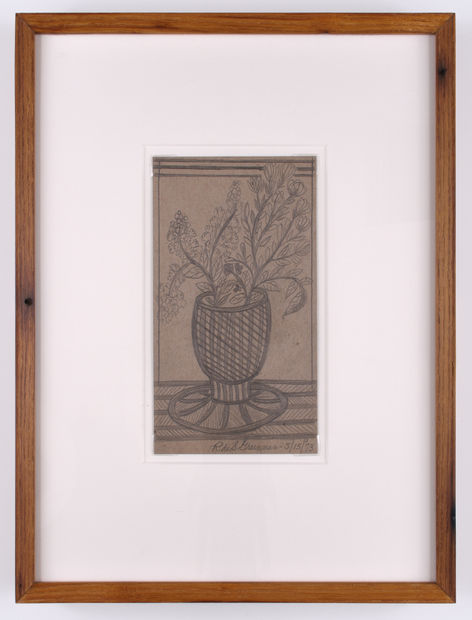
    Seemingly out of nowhere, Greenman (b. Boston, MA), began drawing exultant, radiant vessels and trees obsessively in her 70s over a period of seven years while struggling with Alzheimer's disease. Spending most hours alone, she used pencils, pens, crayons and markers to interpret her world virtuosically - creating demur, constrained drawings of her home, garden, neighborhood in Boston, and family as well as transformative works from her imagination out of saved scraps of paper from family members. Greenman's diminutive vessels and larger botanical and architectural works embody a markmaking which is woven as tightly and expressively as it possesses an all-encompassing reverence and boundlessness.
  • SELBY WARREN 1887–1979 Trunkey Creek, NSW, Australia Warren was an Australian bushman who spent his life in the small settlement...
    SELBY WARREN
    1887–1979
    Trunkey Creek, NSW, Australia

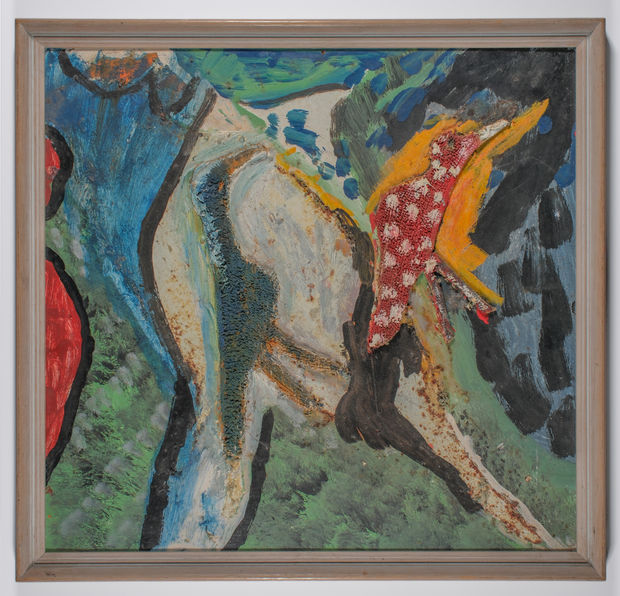
    Warren was an Australian bushman who spent his life in the small settlement of Trunkey Creek and began making visual records of his life experiences in 1963 on found materials using brushes he made with his own hair. that are elemental and soul-stirring. Memory paintings are anchored in rural scenes of his life shearing, as a stockman, itinerant laboring, and in expressions of rural folklore; poems and ballads he liked to recall; iconic Australian landmarks and political figures, fusing his paintings with elaborate frames that are constructions. 
     
    Discovered when he was 85 years old when a painting was seen hung at local pub the Black Stump, Warren drew a great deal of attention over a period of three years after his first exhibition at the age of 85 at Rudy Komon's legendary gallery in Sydney in 1972 – followed by exhibitions in Melbourne and Brisbane which led to much critical and media acclaim. As Komon remarked Warren was "one of Australia's greatest art finds"... "one of a half a dozen like him in the world." 

    "I've lived in the bush all me life. I've seen things that don't happen in Australia any more...So when I took up painting I was able to put it all down."  
    -Selby Warren, in Lenore Nicklin, 'Bush painter waltzes in', Sydney Morning Herald, 24 February, 1972
  • Robert Rapson 1951 - 2020 Wellington, New Zealand Made densely patterned ships with his fingers leaving choppy, impasto imprints in...
    Robert Rapson 1951 - 2020 Wellington, New Zealand Made densely patterned ships with his fingers leaving choppy, impasto imprints in...
    Robert Rapson 1951 - 2020 Wellington, New Zealand Made densely patterned ships with his fingers leaving choppy, impasto imprints in...
    Robert Rapson
    1951 - 2020
     Wellington, New Zealand
     
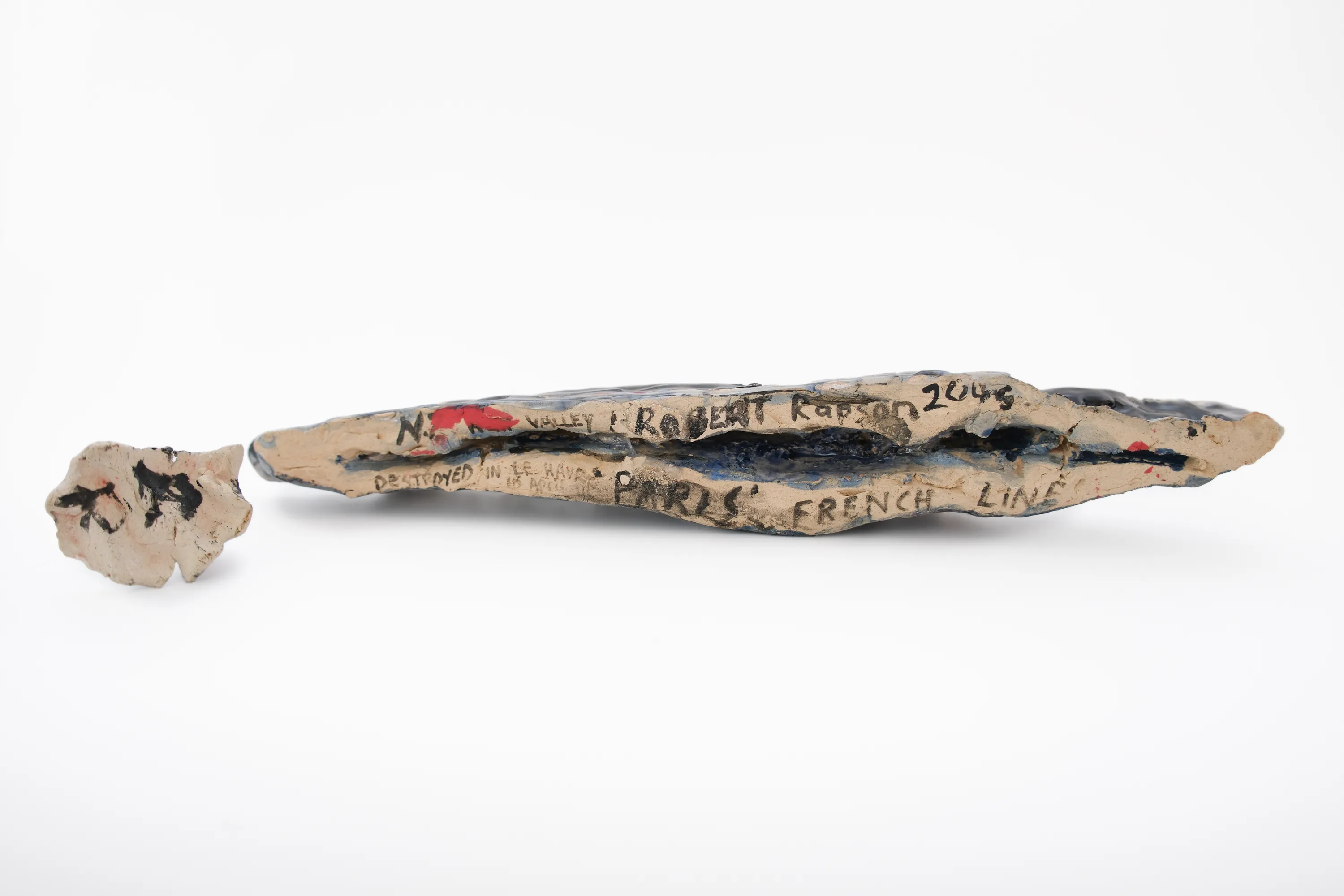
    Made densely patterned ships with his fingers leaving choppy, impasto imprints in the sculptures which become one and the same with swirling seas the ships cut across. Rapson’s fascination with passenger ships came from an early age as he watched the fanfare and bands that accompanied their arrival and departures from Wellington harbor and visited his father who worked on the wharves. As a teenager he sailed to Europe on the Italian liner “Angelina Lauro”. Storied vessels of cultural and historical significance and the romantic idea of the long voyage become charged monuments which as Rapson explains bear “witness to history and change.”

  • Naomi Bushman (b 1946, New York)
    Lives and works in New York
     
    A mathematician who taught math all of her life within a self-proclaimed world of abstraction, Bushman discovered ceramics ten years ago which as she puts it: "gave me permission to play". Living downtown, Bushman has always dreamed of life as an artist. 
  • Alan Constable b. 1956 Lives and works in Melbourne, Australia Alan Constable's singular sculptures of cameras, telescopes, projectors, and binoculars... Alan Constable b. 1956 Lives and works in Melbourne, Australia Alan Constable's singular sculptures of cameras, telescopes, projectors, and binoculars...
    Alan Constable
    b. 1956
    Lives and works in Melbourne, Australia
     
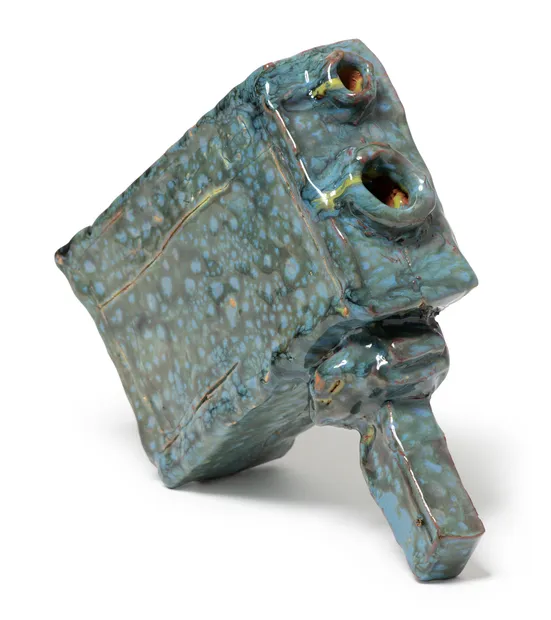
    Alan Constable's singular sculptures of cameras, telescopes, projectors, and binoculars are imbued with a heightened tactility and inner life. Legally blind and deaf, Constable is renowned for his ceramic cameras that reflect his life-long fascination with old cameras, when he began constructing replicas of cameras from cereal cartons and glue at the age of eight. At the studio Constable holds research images or source objects millimetres from his face, committing the form to memory by tracing the surface with his fingertips. Every protrusion, button, and lens of a specific camera model is faithfully captured in intricate detail, down to tiny scrawled lines and letters. Form and perspectives shift and Constable’s re-interpretations become at times anthropomorphic vessels and totems.
    The curator Matthew Higgs stated that "Constable, who is legally blind, makes incredible ceramic sculptures of cameras, which should, in my opinion, be in every major museum collection."
  • Adrian Jangala b. 1962 Lives and works in zz Alice Springs, Northorn Teretory Australia , Adrian Jangala Robertson is an... Adrian Jangala b. 1962 Lives and works in zz Alice Springs, Northorn Teretory Australia , Adrian Jangala Robertson is an... Adrian Jangala b. 1962 Lives and works in zz Alice Springs, Northorn Teretory Australia , Adrian Jangala Robertson is an... Adrian Jangala b. 1962 Lives and works in zz Alice Springs, Northorn Teretory Australia , Adrian Jangala Robertson is an...
    Adrian Jangala
    b. 1962
    Lives and works in zz
    Alice Springs, Northorn Teretory Australia
     
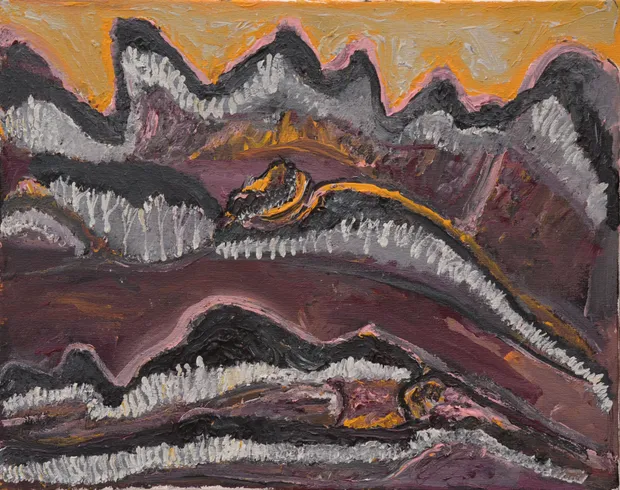
    Adrian Jangala Robertson is an artist with Bindi Mwerre Anthurre Artists: a supported art studio in central Australia for First Nations artists living with disability. Here, Robertson finds his expression through painting. His emotive and freely-worked depictions of family and friends, and of the dramatic landscape of Central Australia, have an emotional intensity that has seen him dubbed 'the Van Gogh of the Central Desert'.
    Born at Papunya, an Aboriginal community in the Central Desert, in 1962, Adrian Jangala Robertson grew up amidst the founding fathers of the Desert Painting movement. (The movement - which saw traditional motifs being set down for first time in permanent and portable form, in paint on board - began at Papunya in 1971, initiated by a group of senior men from the community with the encouragement and engagement of the school art-teacher Geoffrey Bardon.) Robertson now lives in Alice Springs.
     
    The artist's a-temporal connection to his mother's homeland of Yalpirakinu abounds with the profound spiritual knowledge that is part of his inheritance. With a unique and powerful intimacy, he depicts panoramic views and portraits of friends and relatives. Cloud-banks swell and float over red- mountain ridges speckled with bush shrub, or the flash of a 'road train' lorry on an unmetalled road. His vision is as loaded with memories of childhood as it is illustrative of the immediate surroundings.
     
    Adrian Jangala Robertson is the recipient of numerous prestigious prizes for contemporary aboriginal art. In 2024, Roberson received a triple-nomination for the prestigious Wynne, Archibald and Sulman: an unprecedented achievement for an Aboriginal artist. Previous prizes include the Telstra Painting Award (2020), and the coveted Alice Prize in 2022. Yalpirankinu will mark his first solo exhibition outside of Australia.